
March 30, 2020
doom – noun : 1993 first-person shooter developed by …. wait …. how is this what initially comes up on Google?
Have you ever become really (I mean REALLY really) invested in a single Magic deck? Not necessarily financially, mind you. I’m talking about a more emotional investment. It becomes a deck you’ve played dozens or hundreds of time, learned its nuances, tweaked it over weeks or months or even years to make it an unstoppable juggernaut (or just a fantastic play experience.)
I haven’t. Or, I hadn’t, up until the past month or so. Not in all my years of playing had I ever crafted a deck I adored so much that I treated it like a child, nurturing it and helping it grow and thrive. Sure, I had “pet” decks that I kept intact for long stretches of time, to be pulled out on occasion. But none of them lodged in my heart like an adopted shelter cat that curls up in your lap when you’re sad.

Arena allows me to play Magic almost daily, and with my son happy to just dabble in the game for 30 minutes or so every few weeks, it’s Arena where I get my ongoing Magic fix. Though I’m a free-to-play grinder, I’ve learned to squirrel away gold for months in order to “buy” scads of boosters when new sets are released. Theros: Beyond Death was the pinnacle of this strategy. When it was released I spent 100,000 gold to get 100 packs of it, and I then quickly set about making use of all those cards.
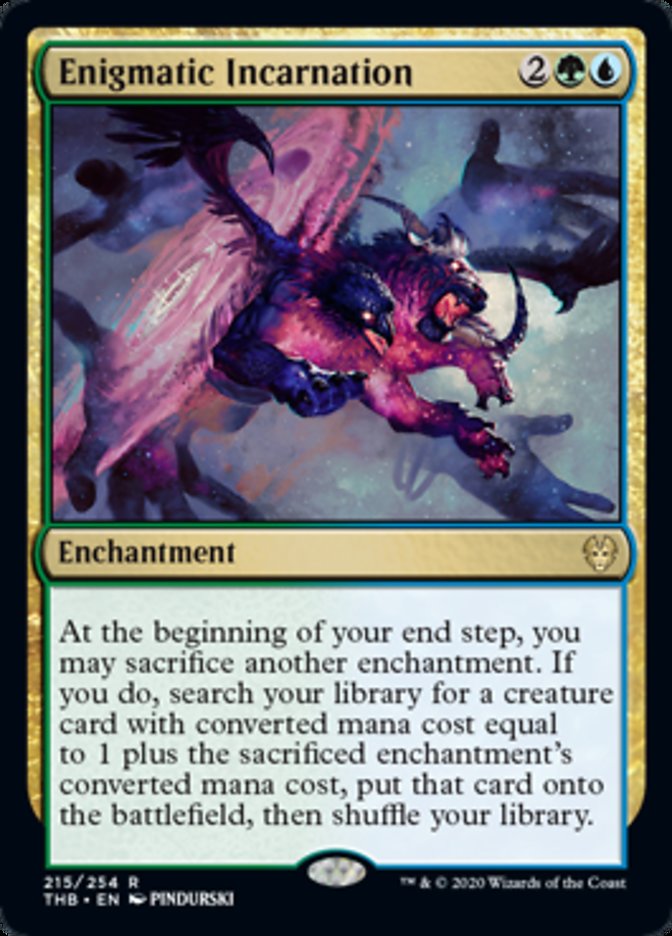
As I’ve mentioned before, Enigmatic Incarnation was the THB card that won my heart initially, and the deck I built around it is still favorited on Arena. I played it extensively for a few weeks, but as is pretty typical for me, I yearned to try other things. Repetition – in music, movies, TV, games – has been anathema to me since I was a teenager. How anyone listens to the same song twice in a row baffles me. People who put a single song on “repeat” are, to my line of thinking, utter psychos.
After playing it extensively for a few weeks, Enigmatic Incarnation gave way to a Boros control deck I played for awhile. Taking one of the most aggressive color combinations and using it to play slower, grindier games was refreshing. Control tends to be synonymous with counterspells, so blue-less control was a joy to play and (I hope) something different for my opponents to play against.
After a few weeks of that my wanderlust awoke and I went trawling for something new. And I found it in something old:
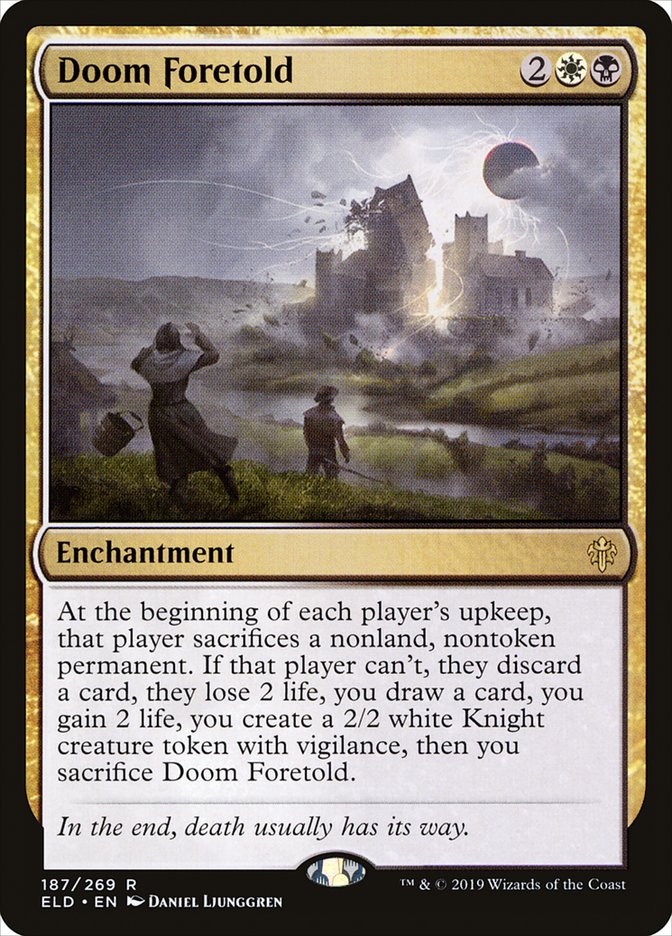
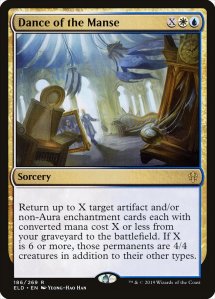
This is a quintessential control card, belonging in the “resource denial” category. Lots of people built decks around it when it was released in Throne of Eldraine, including me. I went with the predictable Dance of the Manse deck, wherein you fill your own graveyard with artifacts and enchantments while preventing your opponent from building out their own board or fully advancing their strategy. Once you hit 8 mana, you can play Dance of the Manse to return 6 artifacts or enchantments from your graveyard to the battlefield, getting whatever bonuses those cards naturally bestow, and turning all of them into 4/4 creatures. Stalling the opponent long enough to get to 8 mana was often the challenge, but a resolved 8-mana Dance of the Manse, if not immediately followed up by a board wipe from the opponent, was typically “virtual good game handshake” time.
Though these sorts of decks never made it to the upper echelons of constructed play, it was frustrating enough to play against that I started seeing not-infrequent concessions to a resolved Doom Foretold. People like keeping their stuff. A card that forces them to sacrifice something every turn requires strategy and patience to endure. I started to feel bad playing that deck, and retired it. Not sure I’ve played it in 2020, honestly.
When I recently saw a Mardu (white/black/red) list that used Doom Foretold, I was intrigued. It still used the somewhat-reviled Doom Foretold, but took the strategy in an intriguing direction thanks to some Theros: Beyond Death cards. I tried the list out, and found it reasonably enjoyable to pilot. It was capable of winning often enough to trot out regularly, and I even beat some tier 1 decks on occasion. Having played my Dance/Doom deck enough last fall to have some idea of how to get the most out of Doom Foretold, I kept playing this new Mardu deck because it felt somehow familiar, even though it plays quite differently from the old Esper (white/blue/black) Dance/Doom deck.
Decklist, as I play it, can be found here: Mardoom
Did you know that if you play a deck often enough, you’ll actually learn how to play it better? Not in the “avoid doing something dumb” sense, but more in the “making the best play in the moment” sense. This shouldn’t be a shocking revelation, I know, but for perhaps the first time in my life, I’ve played a deck enough to build a substantial connection with it. I’ve never stuck with a single deck long enough to learn not only how best to play it, but how to adjust play patterns depending on what the opponent is doing.
I’m not sure why Mardoom (as I so cleverly call it) has been so satisfying to play. It’s competitive but certainly not good enough to regularly beat tier 1 strategies (white/blue control and Simic flash, in particular, just tend to demolish it.) But I recently beat what looked like a fully optimized Temur Clover deck, and I was happily bewildered by that. If I had to speculate, I think I enjoy Mardoom because:
- It doesn’t strike me as particularly oppressive to play against. I’ve never had a mirror match with Mardoom (in fact, I’ve never played anything like it on Arena), so what do I know? But I don’t counter any spells, nor do I use any planeswalkers (the worst of which are indubitably miserable to play against unless you’re running a tier 1 deck yourself.) While I’m certainly trying to win, I want me and my opponent to have a fun and fair game of Magic (when possible.) If you’re troubled by this attitude, then this may not be the deck (or blog) for you.
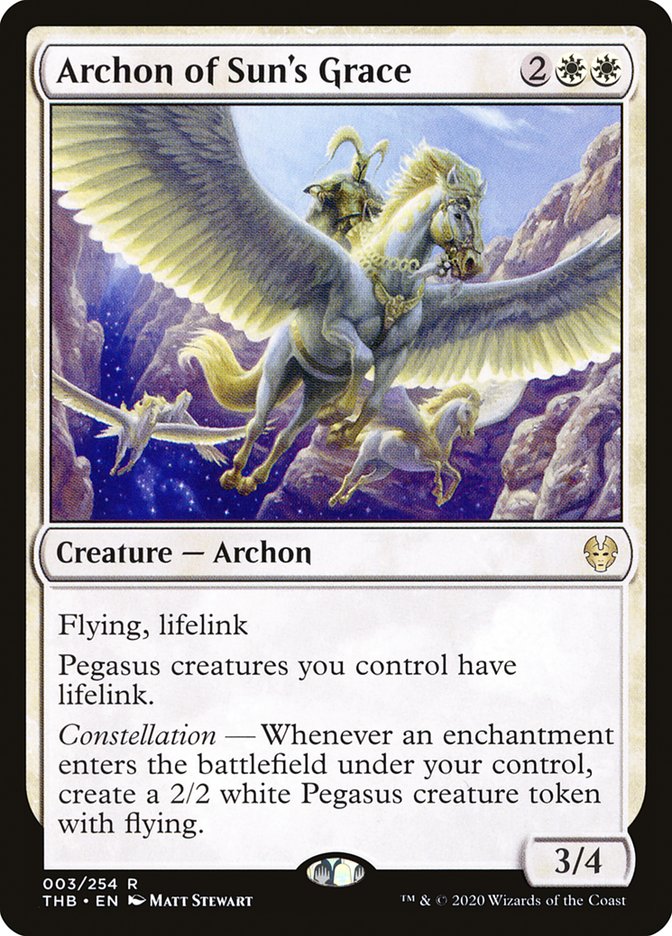
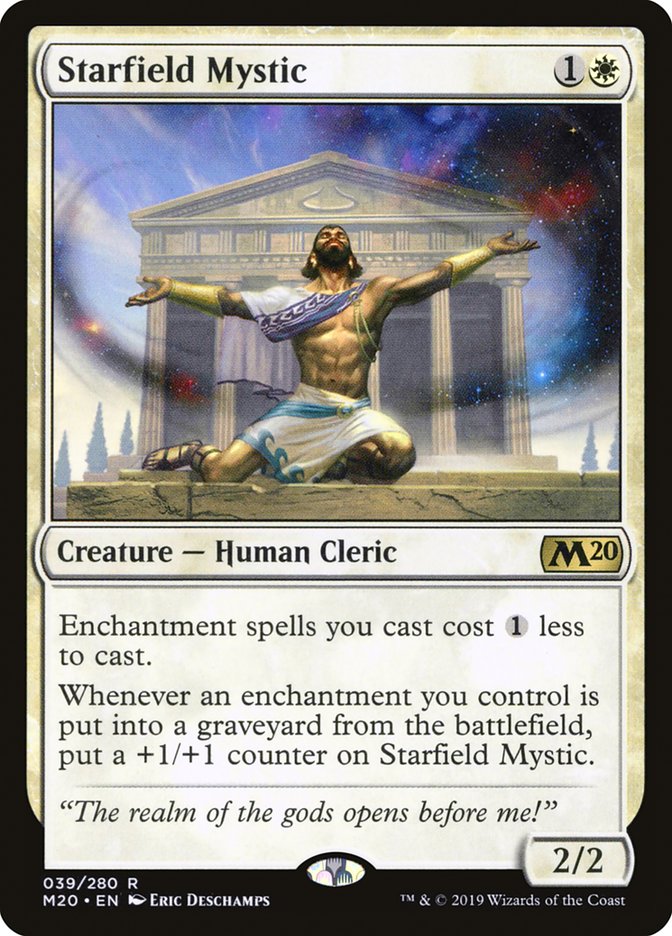
- Its win conditions are not entirely “meta”. I run three copies of Archon of Sun’s Grace, a card I’ve seen in a number of relatively powerful white/blue control decks. In Mardoom, though, it tends to play decoy more often than true threat. Once it drops, most opponents will do what they can to remove it (for good reason.) It eats a lot of removal but otherwise doesn’t affect games as often as you’d think. Beyond that, though, Oulaws’ Merriment and Starfield Mystic are cards I see in other people’s decks only occasionally, but are both frequent win conditions in Mardoom. And God-Eternal Bontu is a card I don’t recall seeing other people play, like…ever.
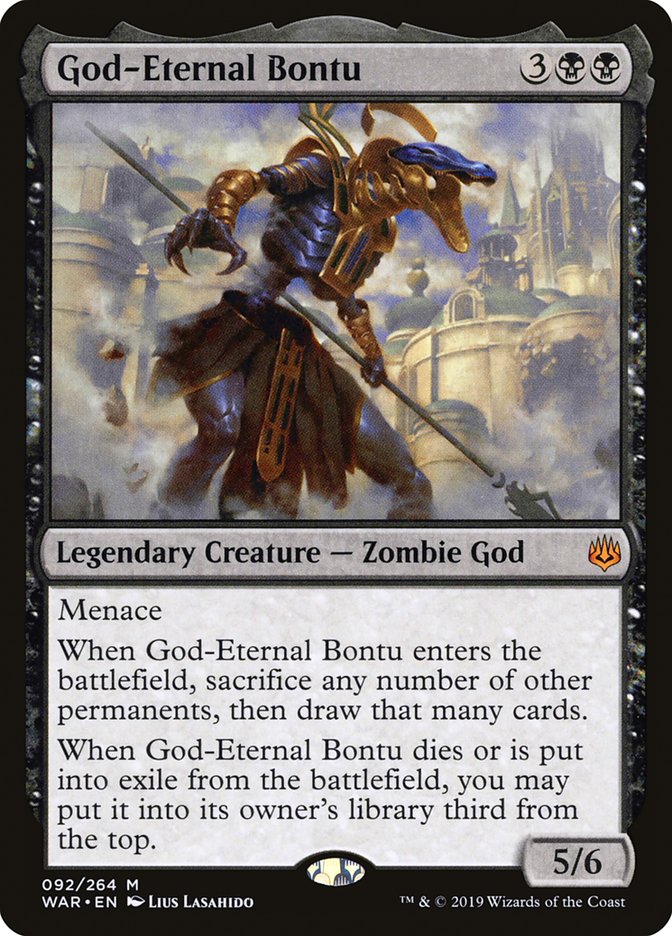
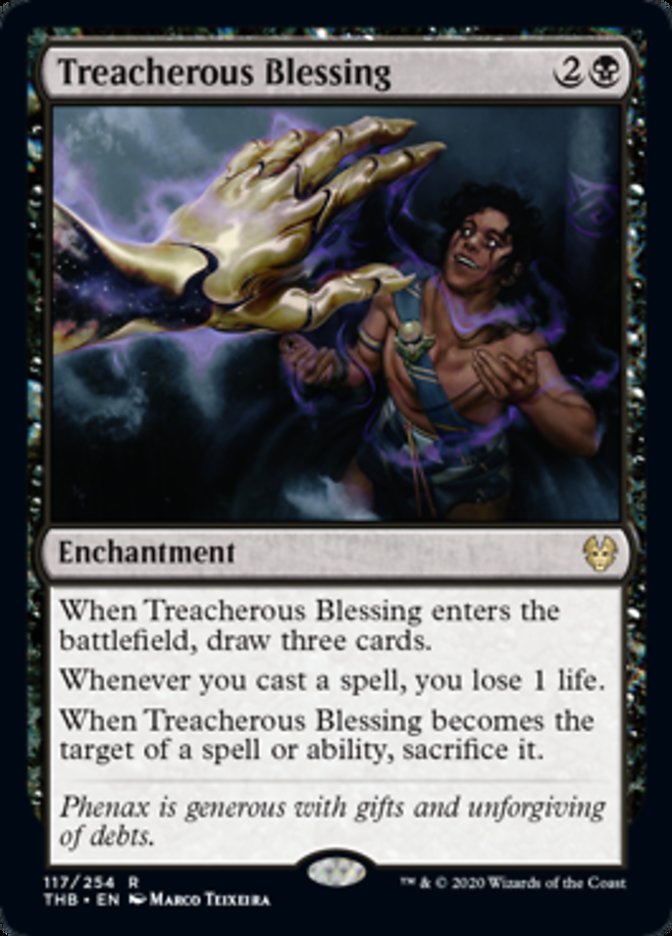
- It runs cheap, wonky stuff like Treacherous Blessing (which, to be fair, belongs in absolutely any Doom Foretold deck) and The Akroan War. Truthfully, The Akroan War should probably be cut if I want a more tuned/optimal build. It can be a blank, or relatively useless, in some situations. But it gives me so much wicked glee to steal something critical to my opponent’s plan. Then sacrificing the stolen troop to a Doom Foretold or Bontu can be rapturously joyful. And it genuinely shocks me how often my opponents will use their own removal spells to kill something of theirs that I’ve stolen, even when it’s something rather innocuous like a Murderous Rider that I’ve nabbed because I’m floundering and trying to buy a turn or two to find answers.
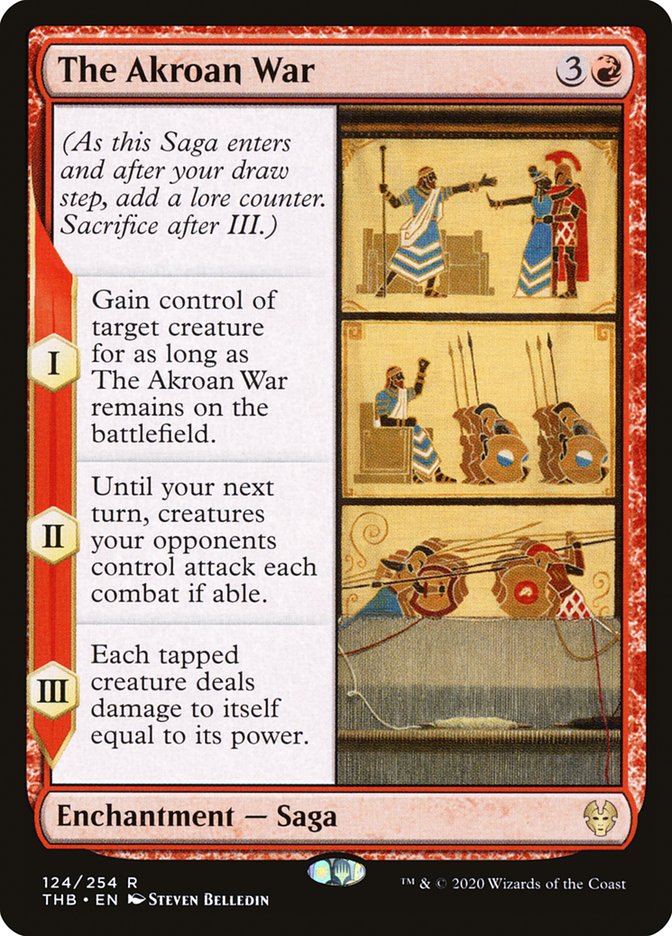
[Full and fair disclosure: The Akroan War has tilted many an opponent, but has also been the source of my largest goofs. Stealing the wrong thing, attacking with the stolen creature instead of holding it back as a blocker, stealing something tapped when I forget that The Akroan War doesn’t untap its target – if you can botch a line of play with The Akroan War, I’ve done it. Many, many times. That’s part of the charm of the card too – learning how to best use it. Even if there are likely dozens of cards that would be better inclusions, The Akroan War is perhaps the ideal balance of grinning fun and grimacing challenge, and I feel like I’m becoming a better player (oh, so very very slightly) each time I use it to try and turn the tide of a game.]
- The deck presents lots of interesting choices. Knowing the right moment to play a Doom Foretold is tricky. Tricky enough that I still get it wrong too frequently (but I’m learning.) When playing this deck my life total becomes a secondary concern as well as a resource, which is quite new to me. I run a lot of shocklands that get played untapped, and I often have to pull the trigger on a Treacherous Blessing without any immediate way to remove it. On occasion I’ve even had two Blessings in play when I’ve panicked and gotten truly desperate to find answers (the second one unfurling into a Bontu feels particularly triumphant.)
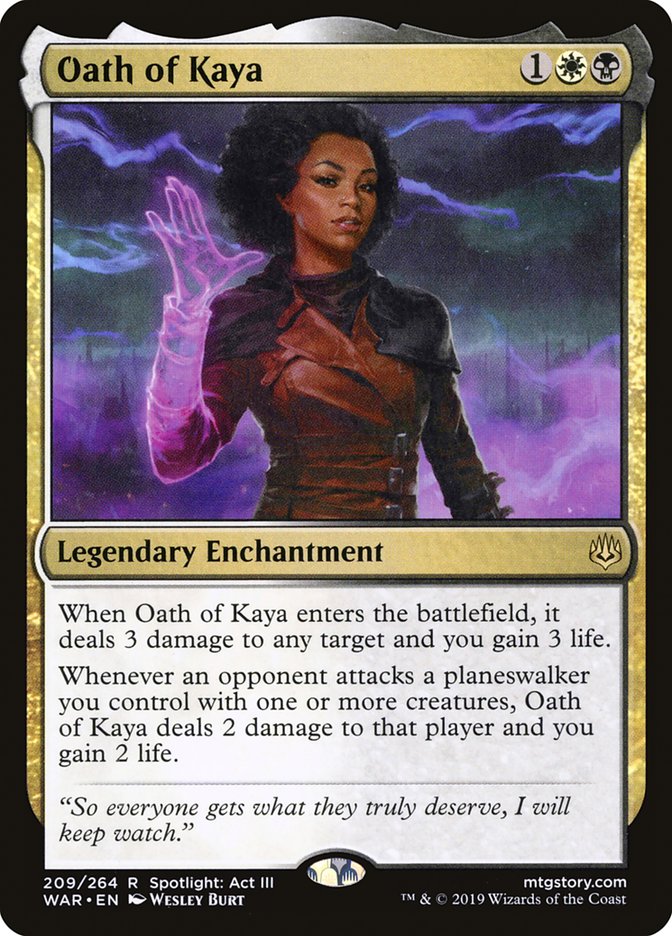
- Being somewhat unusual, opponents frequently make mistakes against it. Though not common, I’ve had people spend removal to get rid of a Oath of Kaya instead of something more threatening on the board, probably because they expect that I’ll be dropping a planeswalker at some point. I also see opponents play something critical when the only permanent on my side of the board is a Doom Foretold. I then proceed to flash in Omen of the Forge at the end of their turn, or even during my upkeep, so that I can keep the Doom Foretold out another turn and force them into sacrificing their essential permanent.
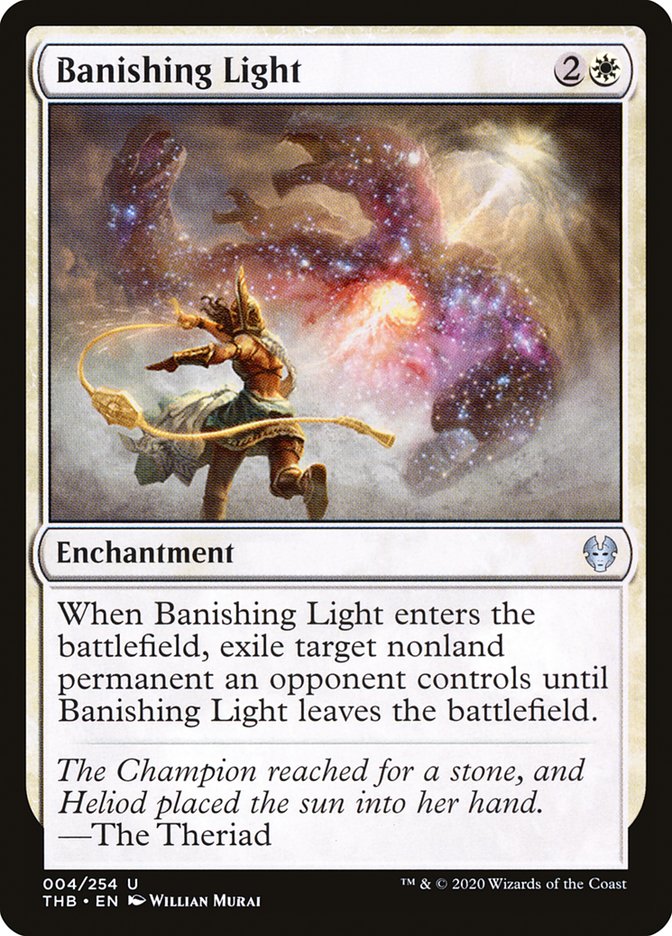
- Answers! Oh, beautiful beautiful answers! Doom Foretold does not discriminate (much) – any non-land, non-token permanent is fair game. Do you know how good it feels to play it when my opponent’s only permanent is a THB God? The deck also has burn/direct damage, life gain, Banishing Light to take care of troublesome permanents, board wipes for anyone choosing to go wide (or play Dream Trawler), and enough card draw to provide hope for an answer even when all hope seems lost.
- Multiple threats: the worst (read as: the best) control decks run lots of counters and/or removal and only a few resilient threats. Games against those decks can last metaphorical eons as the control player sits back, counters or removes anything marginally threatening you attempt to do, and accrues card advantage while doing nothing to actually win for turn after turn. When they’ve finally exhausted your pathetic attempts to play meaningful Magic, and you’re neck-deep into a miserable slogfest, they play Dream Trawler or a similar untouchable or endlessly recurrable threat, and finally work on tearing down your life total.

No one will mistake my deck for a proactive creature jamfest but I have Bontu, Starfield Mystics which have gotten as big as 6/6 or 7/7 if left unattended, and the Archons that can pop out pegasus babies when I (infrequently) untap with it. When those fail, Outlaws’ Merriment will vomit out expendable tokens that can eventually overwhelm an opponent. And while never the primary plan of attack, I’ve finished off opponents at 1 or 2 life by playing a Doom Foretold when they have an empty board.
Games with Mardoom feel highly variable on my end, and my hope is that it presents an interesting challenge to my opponents. I know that Doom Foretold has its haters, as I get the occasional early concession when I play one that forces a player to sacrifice something near and dear to their hearts (usually Heliod in mono-white lifegain.) But it doesn’t monkey with people’s lands, doesn’t stop the opponent from playing their cards, and can be effectively played around (trust me – an opponent flashing in something expendable on their upkeep to protect a permanent I was banking on sniping really irks me.)
Mardoom is what I like to call “Middle Class Magic” (a topic I think I’ll explore more in the near future.) It’s not an optimized tier 1 deck, or even a kludgy simulacrum of a tier 1 deck for someone missing key cards. Nor is it what I think of as jank. There’s no janky theme underlying what I’m trying to do, or janky cards being run for the giggles or memes. Mardoom is an attempt to balance tier 1 chutzpah with casual nonchalance. I want to win, I want to do so in my own (i.e. non-meta) way, and I am fine running relatively strong (i.e. non-janky) cards to do so. I’m avoiding anything particularly oppressive, but also eschewing intentionally weak sub-themes or cards. Efficient removal, including board wipes, are fair game, but I feel no need to ruthlessly optimize the entire list in an attempt to win more games.
Mardoom isn’t as strong as it could possibly be, but I do think it’s as fun as it can possibly be.
 Casual Magicking
4 thoughts on “My New Favorite Pet is…Doom!”